Which of these two statements comes from someone who doesn’t know much about notes?
- “I got a real deal on this note. The yield is 20%.”
- “I got a real deal on this note. The discount is 20%.”
The answer is number 2. The giveaway is the word discount.
The discount is how much less than the balance you pay for a note, as a percentage. On its own it isn’t a very useful number. Experienced note investors care about the yield on their money, and the discount may or may not play a part in it. A 20% discount can produce a terrific yield or an awful one. It all depends on the terms of the note.
Where the “discount rule” comes from
You still hear “discount” used as if that one word summed up the whole note business. Some people who think of themselves as sophisticated investors always sell at the same discount off the balance: 10%, 15% or 20%.
The “discount rule” is especially popular with real estate agents. One of the first things I ever heard about mortgages was this rule, explained to me by an agent:
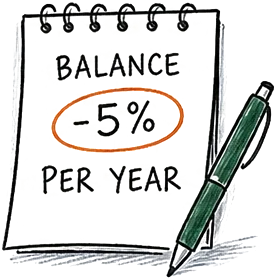
“Take 5% off the balance for every year of the note.”
So a 3-year note supposedly sells for 15% off, a 4-year note for 20% off, and so on. Simple. Fast. Wrong. Let’s run the numbers.
Two notes, one discount
Choose the note you’d rather buy. Note #1: $10,000 face amount, 12% interest-only, balloon in 4 years, bought at a 20% discount. Note #2: the same note with an 8% interest rate, also bought at 20% off.
In the tables, N is the number of monthly payments, I is your yield at the price you pay, PMT is each payment, PV is what you pay for the note ($8,000 is 20% off $10,000) and FV is the balloon.