
Module 4 · Pricing & Negotiation

The Myth of the Discount Rule

Why “5% off for every year” costs note buyers money, shown with real numbers.

By W. J. Mencarow · 4 min read · Lesson 4.19

Notepad reading “Balance −5% per year”

Which of these two statements comes from someone who doesn’t know much about notes?

  1. “I got a real deal on this note. The yield is 20%.”
  2. “I got a real deal on this note. The discount is 20%.”

The answer is number 2. The giveaway is the word discount.

The discount is how much less than the balance you pay for a note, as a percentage. On its own it isn’t a very useful number. Experienced note investors care about the yield on their money, and the discount may or may not play a part in it. A 20% discount can produce a terrific yield or an awful one. It all depends on the terms of the note.

Where the “discount rule” comes from

You still hear “discount” used as if that one word summed up the whole note business. Some people who think of themselves as sophisticated investors always sell at the same discount off the balance: 10%, 15% or 20%.
Balance scales weighing cash against a calendar

The “discount rule” is especially popular with real estate agents. One of the first things I ever heard about mortgages was this rule, explained to me by an agent:

“Take 5% off the balance for every year of the note.”

So a 3-year note supposedly sells for 15% off, a 4-year note for 20% off, and so on. Simple. Fast. Wrong. Let’s run the numbers.

Two notes, one discount

Choose the note you’d rather buy. Note #1: $10,000 face amount, 12% interest-only, balloon in 4 years, bought at a 20% discount. Note #2: the same note with an 8% interest rate, also bought at 20% off.

In the tables, N is the number of monthly payments, I is your yield at the price you pay, PMT is each payment, PV is what you pay for the note ($8,000 is 20% off $10,000) and FV is the balloon.
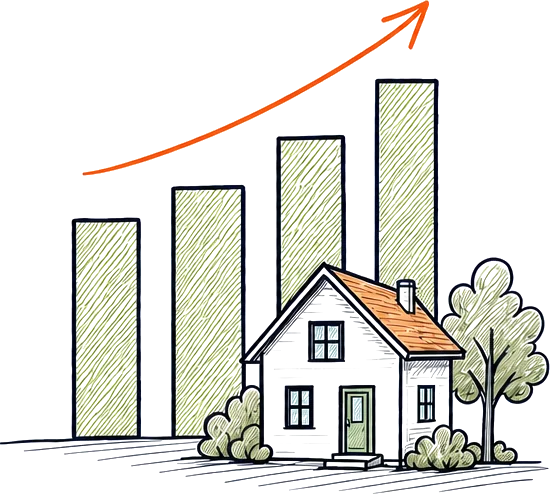

Worked example: two notes, same 20% discount

Note #1

NIPMTPVFV
4819.2%$100.00$8,000$10,000

Note #2

NIPMTPVFV
4814.6%$66.66$8,000$10,000

Same discount, 4.6 points less yield.

Here’s where the discount rule falls apart. Pay $8,000 for Note #1 and your yield is 19.2%. Change just one thing, the interest rate, and the same discount drops your yield to 14.6%.

When 20% beats 25%

Let’s make it tougher. Discount Note #2 by 25%, to $7,500. You can buy Note #1 for $8,000, or save $500 and buy Note #2 for $7,500. Which one do you want?

NoteNIPMTPVFV
#14819.2%$100.00$8,000$10,000
#24816.6%$66.66$7,500$10,000

In this case a 20% discount beats a 25% discount. At 25% off, Note #2 yields 16.6%, almost three points less than Note #1 at 20% off. You’d need a 31% discount on Note #2 to match.

Yet plenty of people will tell you that both are 4-year notes, so both should sell at 20% off. Listen to them and you’d pay $8,000 for Note #2, when $6,890 matches the yield of Note #1. That’s over $1,100 down the drain.

Why the rule fails

The discount rule takes one variable and applies a hard-and-fast standard to every note. That can’t work:

  • It ignores the interest rate and the payment schedule.
  • It assumes yearly payments (“5% per year”), while most notes under $100,000 pay monthly.
  • It ignores the market. The same discount is applied whether Treasury bills pay 2% or 10%, and if a T-bill pays 10%, why would you buy a note yielding 8%?
  • It ignores whether the note is amortized or interest-only.

Here’s that last point in numbers: a fully amortized 5-year, $10,000 note at 12%, and the same note interest-only with a balloon. Both are bought at the rule’s price of $7,500 (5% off per year).

NoteNIPMTPVFV
Amortized6025.5%$222.44$7,500$0
Interest-only6019.9%$100.00$7,500$10,000

A 19.9% yield is very good, but wouldn’t you rather have 25.5%? Again, the discount rule costs you money.

If you want some fun, ask someone who swears by the rule: “Since you take 5% off per year, do you have any 20-year notes you’ll give me for free?”

Key takeaways

  • Yield matters, discount doesn’t
  • Interest rate and payment schedule change everything
  • Never price a note with a rule of thumb
  • Run the numbers on every note

Try it yourself

Price Note #2 to match a 19.2% yield.

Show answer

$6,890. At that price, Note #2 yields the same 19.2% as Note #1.

Keep going

Learn the full method, step by step.

Start the Course

No hype. No income claims. Just the real numbers.

Start the Course Curriculum



